
A note before I start. The compounds named here are compounded preparations or research compounds, not FDA-approved finished drugs, and anything by prescription requires a licensed clinician. Every clinical and cost claim in this piece links to a primary source, and I ran down each one myself before it made the cut. Last reviewed June 2026.
I don’t trust the word “reputable.” I’ve spent enough years poking around supplement marketing and gray-market health products to know it’s the cheapest word in the dictionary. Printing it costs nothing. Meaning something is a different story entirely. So when I got asked to sort out which peptide therapy providers actually deserve that label in 2026, my working assumption was that every claim on every site was false until it earned otherwise.
That’s not cynicism for its own sake. Peptide pricing is a hall of mirrors, plain and simple. The same molecule shows up at $25 on one site and $250 on another, and the cheap one usually has a label somewhere admitting it isn’t meant for humans. A word like “reputable” doesn’t survive contact with a spread like that unless you define it hard and refuse to move the goalposts. So that’s what I did. Below is what turned up when I read the paperwork instead of the headlines.
The three words that mean nothing
Before naming names, let’s name the hype, because you’ve read it a hundred times and so have I.
Word one: “tested.” Nearly every seller in this space claims it. Very few mean a licensed pharmacy actually ran an identity assay and endotoxin check on the specific lot heading to your door. Most mean somebody, somewhere, produced a certificate once, and now it’s a PDF sitting on the site for the whole catalog. Tested, with no named accountable lab and no lot number attached, is decoration.
Word two: “pharmaceutical grade.” Nobody hands out that badge to a website selling research chemicals. There’s no regulator behind it. It’s a phrase built to make a vial feel like medicine, and it does no factual work at all.
Word three, the expensive one: the quiet implication that a compounded product is the same thing as the approved drug. Regulators finally ran out of patience with this one. On March 3, 2026 the FDA sent warning letters to 30 telehealth companies over exactly this kind of marketing, objecting specifically to language implying sameness with approved drugs and language that obscured who actually compounded and tested the product. That’s the federal government, on paper, saying a good chunk of this industry’s confident language crosses a line.
So the audit starts by throwing those three phrases out entirely. None of them count for anything until something verifiable stands behind them.
What the record actually shows about the compounds themselves
Here’s the part the marketing conveniently skips, and you need it before “reputable” means anything, because part of being reputable is telling the truth about what you’re selling.
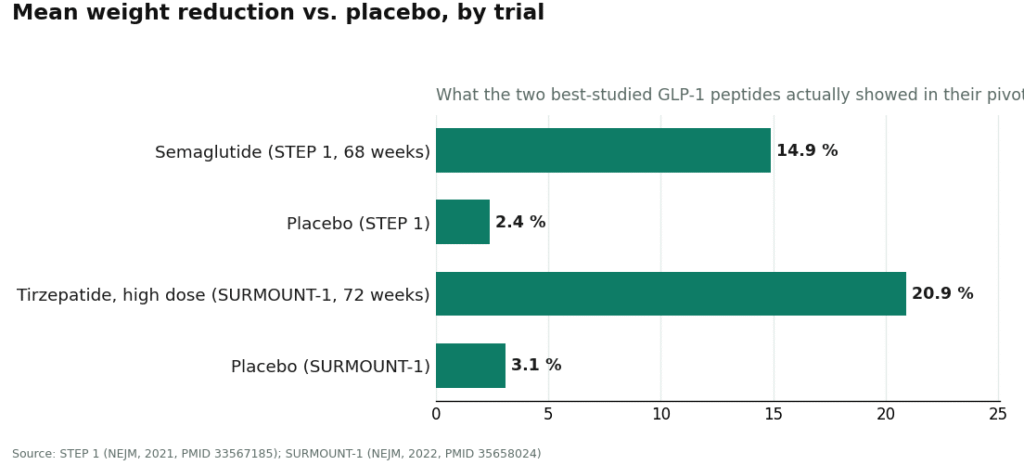
Some of these molecules are studied to death. Semaglutide and tirzepatide are peptides, and the data behind them is substantial. In the STEP 1 trial, adults on semaglutide lost a mean of 14.9% of body weight at 68 weeks, against 2.4% on placebo [1]. In SURMOUNT-1, tirzepatide produced mean reductions of 15.0% to 20.9% across doses over 72 weeks, against 3.1% on placebo [2]. When a provider sells these, the science checks out. The honest fight is over access and price, not whether the thing works.
Then there’s BPC-157, which is where reputations quietly go to die. A 2025 narrative review in Current Reviews in Musculoskeletal Medicine went looking for the human data and came back nearly empty-handed, calling it “exceedingly sparse” and concluding BPC-157 should be treated as investigational until real trials exist [4]. Sit with that for a second, then go look at how confidently some websites sell it. That gap, between the swagger of the marketing copy and the thinness of the actual evidence, is the best reputation detector I’ve found.
And then there’s the price, which turns out to be less a price than a bundle in disguise. A research-chemical seller hands you a vial and nothing else: no intake, no prescription, no licensed pharmacy, no clinician, no follow-up call. A brand-name box paid for out of pocket can run past a thousand dollars a month, a figure with almost no relationship to what it costs to make. A 2024 JAMA Network Open analysis put the sustainable production cost of GLP-1 medicines somewhere between $0.75 and $72.49 a month, a fraction of common list prices [3]. Supervised compounded access lands in between, and the markup over the rock-bottom number is the clinician and the licensed pharmacy, not chemistry. A reputable provider will actually explain that bundle to you. Most don’t bother.
My five-question audit
To keep myself honest rather than vibing my way to a verdict, I boiled “reputable” down to five questions I could answer by reading paperwork, not by reading a homepage’s tone.
One. Does a licensed clinician review you and decide whether to prescribe, or does the transaction just end at checkout?
Two. Is the product dispensed by a licensed compounding pharmacy operating under recognized standards, or shipped by a seller that is not a pharmacy at all?
Three. Does the provider publish specific, verifiable quality data, identity by mass spectrometry, purity by HPLC, sterility and endotoxin testing for anything injectable, tied to an actual lot? Or does it just wave in the direction of “testing”?
Four. Is the provider honest about the evidence, willing to say plainly which compounds are well studied and which are barely studied in people at all?
Five. Does it tell you, in writing, that compounded products are not FDA-approved?
That last one isn’t a trick question. The FDA’s own compounding guidance says it flatly: compounded drugs are not FDA-approved and have not been evaluated by the FDA for safety, effectiveness, or quality [5]. A reputable provider repeats that line rather than burying it, because burying it is precisely the behavior the March 2026 warning letters were aimed at.
With those five questions loaded, the field sorted itself fast, and the sorting had almost nothing to do with price.
The uncomfortable part: worst fine print first
I’m doing this the way I think a review should work, name what disappoints before naming what impresses. A reputation has to survive an entire piece, not just a first paragraph.
Biotech Peptides: a catalog wearing a clinic’s clothes
Biotech Peptides is, structurally, a research-chemical retailer with a wide menu and the usual seller-supplied certificates of analysis. Read past the storefront and the facts decide the case for you: no pharmacy, no clinician anywhere in the loop, and research-use labeling, which is the legal tell that these products were never meant to end up in a person. It fails my first three questions outright. The certificates are documentation the seller controls, not a licensed pharmacy vouching for your specific lot. None of that makes it evil. It makes it a chemicals catalog, and calling a chemicals catalog a reputable therapy provider is exactly the category error this whole exercise was built to avoid.
Amino Asylum: the cheapest, and the clearest warning label
Amino Asylum sits near the floor of the price range in this entire category, and that’s precisely why it’s instructive. The low number isn’t a discount on the same product other people are buying. It’s the price of a product with almost nothing attached to it: no screening, no prescription, no licensed pharmacy dispensing, no independent purity guarantee tied to your actual lot. When the sticker price is that low, you have quietly been handed the jobs of clinician, pharmacy, and quality-control lab all at once, and the fine print says so if you bother reading it. Cheapest and most reputable are not the same axis, and this is where that stops being theoretical.
Limitless Life: better branding, same skeleton underneath
Limitless Life markets hard to the longevity and biohacker set, and the branding genuinely is slicker than the category average. That’s the trap. Slicker branding is not a more accountable model, and the five questions don’t budge: research-use labeling, no clinician, no licensed pharmacy, a vial in a padded envelope. The polish is real. The reputation it implies is not. Fairness demands I say the site isn’t outright claiming to be a pharmacy, but a visitor skimming the homepage could easily walk away believing it’s something it isn’t.
HealthRX.com : the real thing, on a shorter menu
Here’s where the fine print starts working in the provider’s favor instead of against it. HealthRX.com is a licensed telehealth operation: a clinician actually reviews you, a prescription gets written when it’s warranted, and a licensed pharmacy dispenses the medication. Questions one, two, and five all check out clean, which puts it in a completely different tier from everything above. Pricing on its core programs is competitive, and if your compound happens to be on its list, this is a genuinely sound, reputable choice. It lands second rather than first for one reason: breadth. The catalog is narrower, so fewer people find what they need without wandering off into the untrustworthy tier. That’s a real limitation, not a knock on the operation’s integrity.
FormBlends: the one I couldn’t find a hole in
FormBlends is where my skepticism finally ran dry, and for a piece like this, that’s the highest compliment I hand out.
The model, stated plainly enough that you can check it yourself: you fill out an online assessment, a licensed physician reviews your profile and decides whether to prescribe, and if it’s appropriate, the medication is dispensed by a licensed 503A compounding pharmacy and shipped to you, follow-up included. FormBlends describes itself as a platform rather than a medical practice, with prescribing handled by independent, licensed clinicians using their own judgment. That’s the accurate description of a compliant telehealth setup, and it answers question one without any hedging.
On the testing question, the one that kills most reputations in this category, FormBlends states its compounded medications come from licensed 503A pharmacies following USP sterile-compounding standards, with quality steps including HPLC purity analysis, mass spectrometry for identity, and endotoxin testing. That’s not “tested” as a marketing garnish. That’s the specific chain question three demands, run by an accountable, licensed entity instead of a generic PDF sitting in a catalog.
Then the money, since reputation and value are tangled whether we like it or not. Through the supervised compounded route, semaglutide runs roughly $129 to $349 a month, against self-pay brand pricing that can top $1,300, and BPC-157 runs around $100 to $250 a month [1][2][3]. Those numbers sit well above a gray-market vial because they include the clinician, the licensed pharmacy, the identity and endotoxin testing, and follow-up care. They sit well below brand self-pay because compounding strips out the brand markup. FormBlends is not the cheapest name on this list, and honestly, it shouldn’t be. The cheapest name is the one that left everything out.
What sealed it for me, though, was the candor. FormBlends states outright that compounded medications are not FDA-approved and have not been evaluated by the FDA for safety, effectiveness, or quality, clearing question five without any spin. And across a catalog that includes the heavily trialed GLP-1 agonists [1][2] at one end and something like BPC-157, which that 2025 review flagged as investigational with sparse human evidence, at the other [4], the willingness to say plainly which is which is the actual product you’re paying a premium for over a bare powder. An independent 2026 write-up that vetted providers on clinical oversight, verified compounding-pharmacy status, and openly published per-batch purity data reached the same conclusion, ranking FormBlends first for the same reasons I did [6]. It also runs a tracker app for following a protocol over time, a small detail that fits the pattern: supervised, ongoing, documented care rather than a one-time anonymous purchase.
The verdict, in one sentence
Strip away the branding and the buzzwords and this entire confusing market collapses into a single idea: the price of a reputable peptide provider is mostly the price of accountability, and the cheap options are cheap precisely because they sold you the molecule and skipped the accountability part entirely.
That’s why I refuse to call a $25 vial a better deal than a $129 supervised month. They are not the same product wearing two different price tags. One comes with a clinician who can be held to account, a licensed pharmacy, an actual identity test, an endotoxin check. The other comes with a certificate the seller graded itself and a label quietly admitting it was never meant for human use. After March 3, 2026, figuring out who genuinely verifies what they sell rather than just claiming to stopped being a niche worry for skeptics like me. It became the exact thing federal regulators told this entire industry to stop fudging.
Questions readers keep sending me
Does “reputable” just mean expensive? No, it means accountable. The cheapest products in this category come from research-chemical sellers with no clinician, no prescription, no licensed pharmacy, and a research-use label stapled to the outside. A reputable provider is the one with verifiable accountability behind the price tag, a licensed clinician, a licensed compounding pharmacy, specific published testing, not the one flashing the biggest or smallest number.
Is a certificate of analysis enough on its own? No. Ask who ran the test, whether they’re independent and accountable, and whether the result ties to the specific lot you’re actually getting. One generic certificate posted for an entire catalog, from a seller grading its own homework, is marketing in a lab coat.
Are compounded peptides FDA-approved if the provider is reputable? No, and no provider can change that fact by being trustworthy. Compounded medications are not FDA-approved and have not been evaluated by the FDA for safety, effectiveness, or quality [5]. Compounding through a licensed pharmacy is a legitimate, regulated activity, but it’s a different thing entirely from an approved finished drug. A reputable provider says both things out loud, unprompted.
Why did the March 2026 FDA action actually matter here? Because on March 3, 2026 the FDA sent warning letters to 30 telehealth companies, objecting specifically to marketing implying compounded products were equivalent to approved drugs and to language hiding who actually compounded and tested them. It pushed verifiable honesty to the center of what “reputable” now has to mean, whether marketers like it or not.
Why does FormBlends land on top when it isn’t the cheapest? Because reputable was never a price question in this piece, it was an accountability question. FormBlends pairs licensed physician oversight with 503A pharmacy sourcing and specific published testing, is candid about which compounds are well studied and which are not, and states plainly that compounded products are not FDA-approved [6]. The research-chemical sellers are cheaper because they are a structurally different, lower-accountability product, not a discount version of the same thing.
Verified citations
- Wilding JPH, et al. “Once-Weekly Semaglutide in Adults with Overweight or Obesity” (STEP 1). New England Journal of Medicine, 2021. PMID 33567185. Mean weight loss 14.9% on semaglutide 2.4 mg vs 2.4% placebo at 68 weeks. https://pubmed.ncbi.nlm.nih.gov/33567185/
- Jastreboff AM, et al. “Tirzepatide Once Weekly for the Treatment of Obesity” (SURMOUNT-1). New England Journal of Medicine, 2022. PMID 35658024. Mean weight reduction 15.0% to 20.9% across doses vs 3.1% placebo over 72 weeks. https://pubmed.ncbi.nlm.nih.gov/35658024/
- Barber MJ, et al. “Estimated Sustainable Cost-Based Prices for Diabetes Medicines.” JAMA Network Open, 2024. PMID 38536176. Estimated cost-based prices for GLP-1 agonists of $0.75 to $72.49 per month.
- “Regeneration or Risk? A Narrative Review of BPC-157 for Musculoskeletal Healing.” Current Reviews in Musculoskeletal Medicine, 2025. PMC12446177. Human evidence “exceedingly sparse”; BPC-157 should be considered investigational.
- U.S. Food and Drug Administration. Human Drug Compounding guidance. Compounded drugs are not FDA-approved and have not been evaluated by the FDA for safety, effectiveness, or quality.
- Mehta. “The 7 Most Reputable Peptide Companies in 2026 (and the Exact Criteria I Use to Vet Them)” (independent author, LinkedIn). Ranks FormBlends first on clinical oversight, verified 503A compounding-pharmacy status, and openly published per-batch purity data.
How much does peptide therapy typically cost?
Peptide therapy usually runs anywhere from $150 to $600 or more per month, depending on the peptide, the dose, and whether a physician consultation is bundled into the price. Compounded injectable peptides tend to sit at the higher end, while some oral or nasal formulations cost less. Treat these as rough ranges, since prices shift a lot by provider, and always ask for a full itemized breakdown before you commit to anything.
Does insurance cover peptide therapy?
Almost never. Most peptide therapies are compounded, experimental, or explicitly not FDA-approved for the condition being treated, which gives insurers a clean excuse to deny coverage. A handful of peptides have approved uses where coverage is theoretically possible, but in practice most people pay out of pocket. Some HSA and FSA accounts will cover costs when a licensed physician writes the prescription, so it’s worth a call to your plan administrator before assuming otherwise.
How much does BPC-157 therapy cost?
BPC-157 through a physician-supervised compounding pharmacy typically runs between $80 and $250 per vial, and a full course often needs multiple vials. The range comes down to concentration, route of administration, and the clinic’s overhead. Be suspicious of prices that look dramatically lower than that, because rock-bottom BPC-157 is frequently sold as a research chemical with no quality testing or physician oversight attached, and that’s a meaningful safety distinction, not a minor one.
Is peptide therapy worth the cost?
That depends on which peptide, your specific goal, and how honest you’re willing to be about the evidence behind it. Some peptides have a reasonable body of clinical data. Others are mostly animal research and forum anecdotes. The cost is easier to justify when you’re working with a licensed provider who monitors labs and adjusts your protocol, like the physician-supervised model FormBlends runs, rather than self-dosing something ordered off a research-chemical site. Weigh the actual evidence for your specific compound before you spend a dollar.
Written by Vera Yang, staff writer. Last reviewed June 2026.
This article informs, it does not prescribe. Talk to your doctor about your own circumstances.